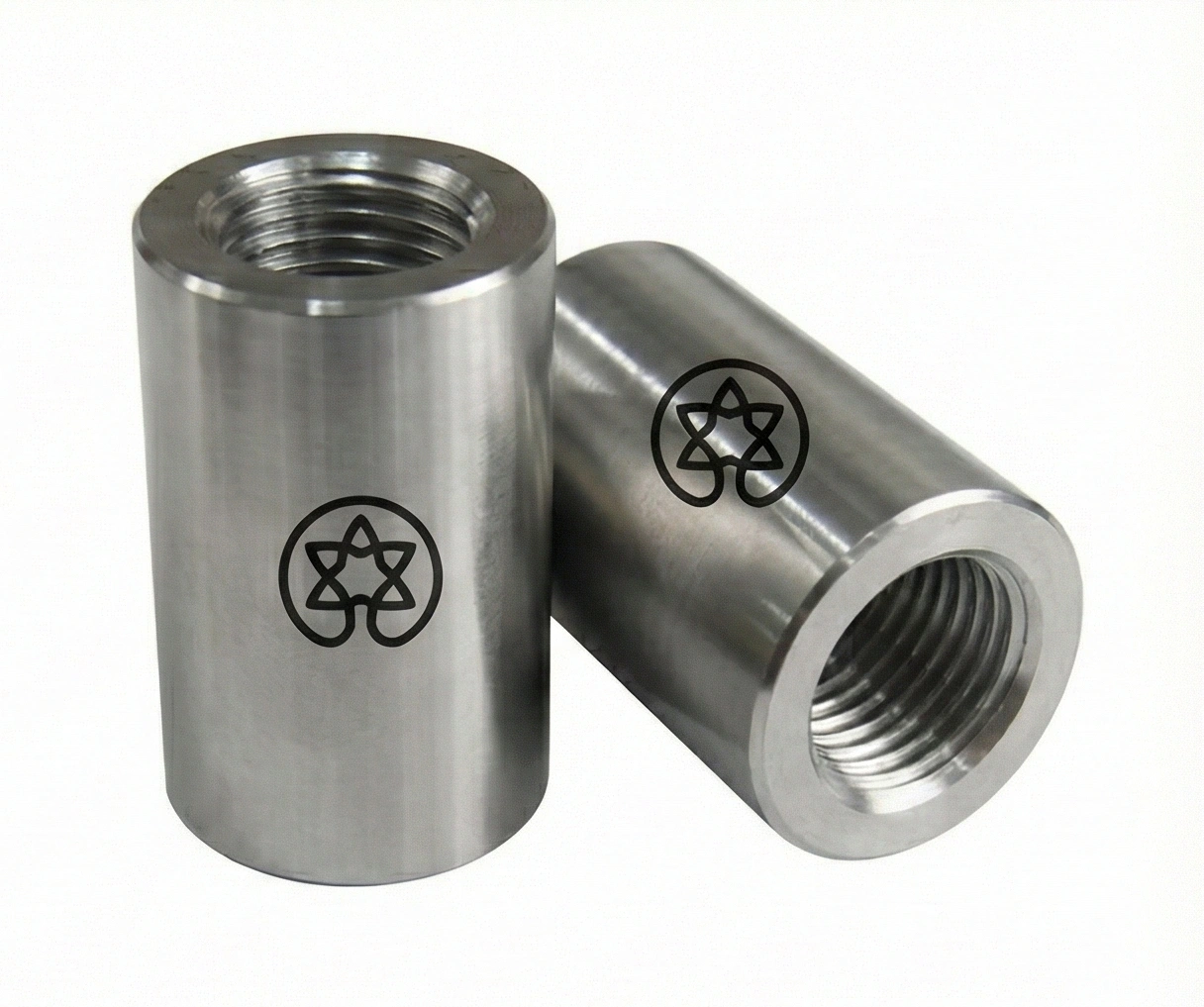
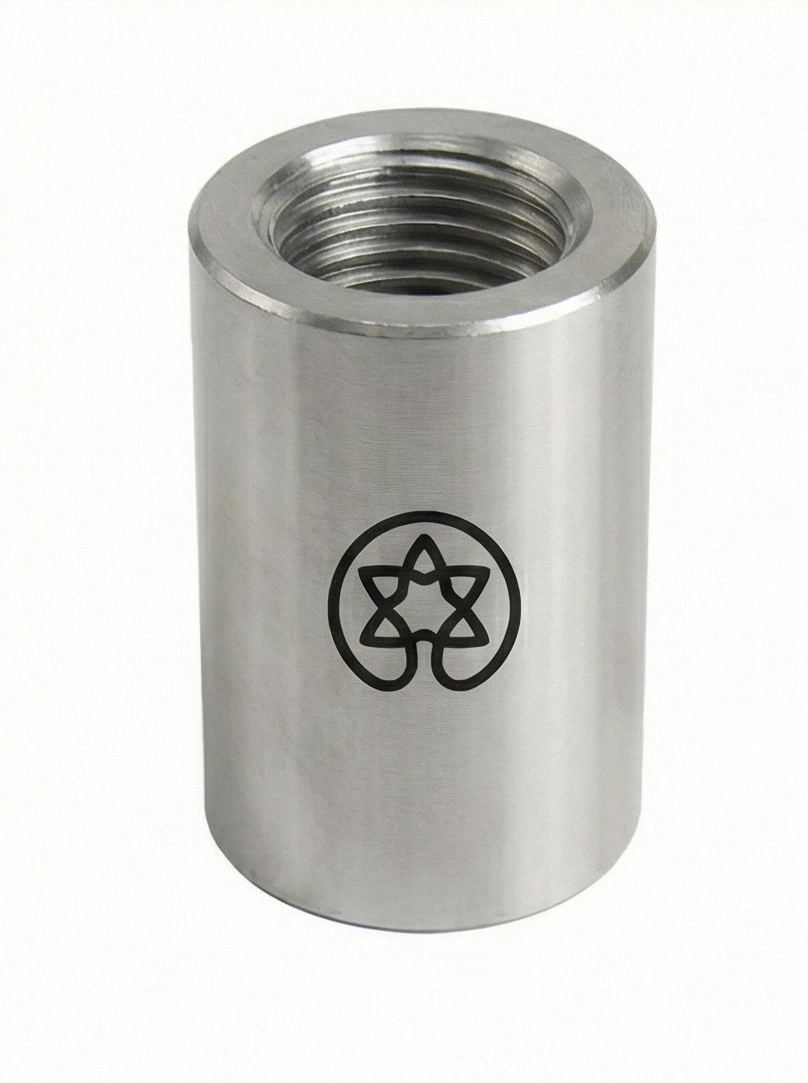
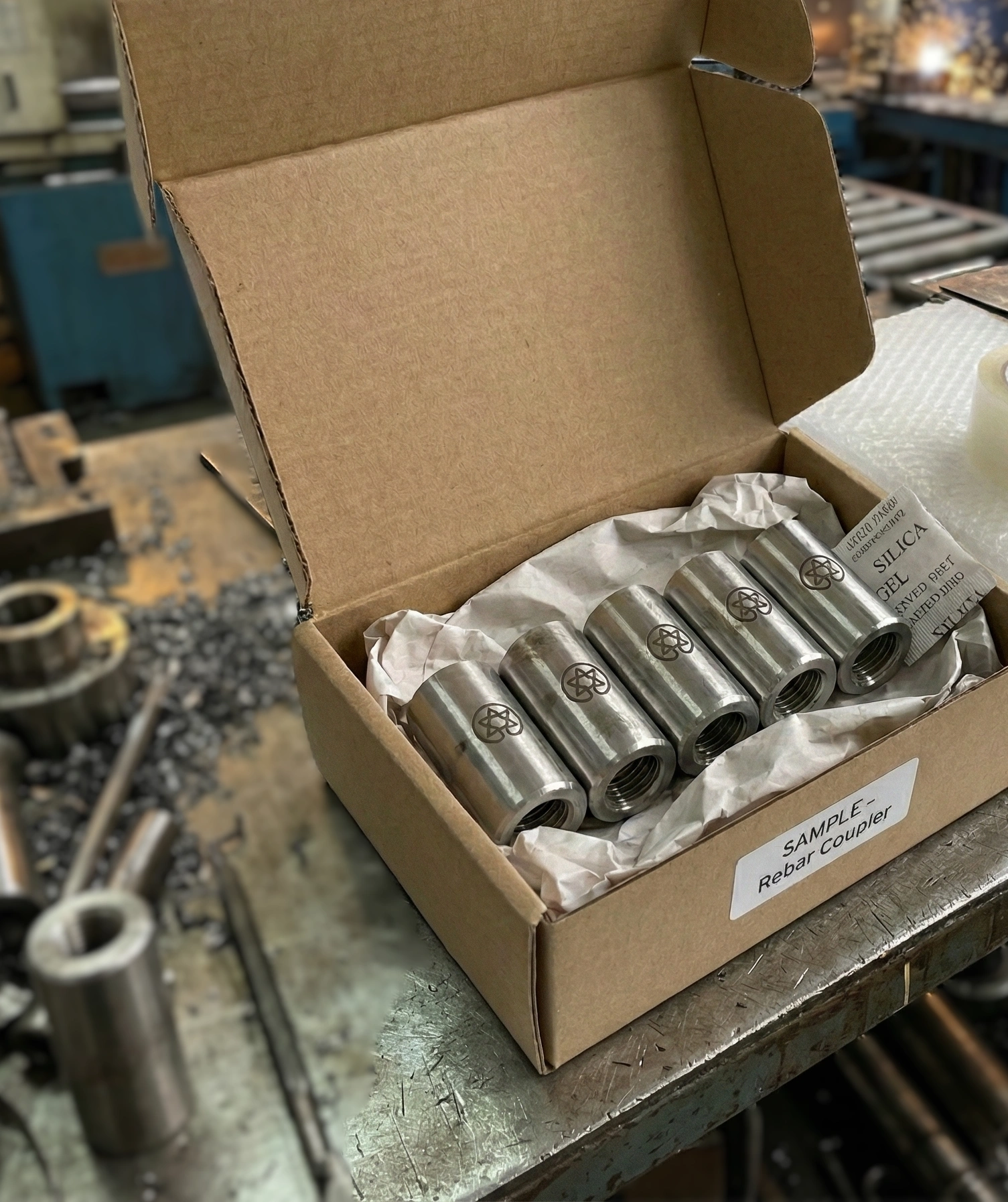
High-tensile steel rebar couplers engineered for seamless, end-to-end mechanical splicing in reinforced concrete structures. Precision CNC threaded with a strict ±0.05mm tolerance to guarantee superior load transfer and eliminate rebar congestion. Finished with industrial Black Oxide. Exporting globally from our facility in Mumbai.
In modern high-rise and infrastructure construction, traditional rebar lapping is increasingly being replaced by mechanical splicing. Lapping wastes expensive steel and creates severe rebar congestion in columns, making concrete pouring difficult. Our High-Tensile Rebar Couplers solve this by joining two reinforcement bars end-to-end, transferring the structural load completely and seamlessly.
At OM Engineering Works, we manufacture these critical structural components using our extensive Traub machining and CNC turning infrastructure. The internal threads of the coupler are the most vital element of mechanical splicing. By maintaining a strict ±0.05mm tolerance, we ensure that the rebar threads mate perfectly with the coupler, creating a joint that is often stronger than the rebar itself.
Operating out of our advanced facility in Bhayandar, Mumbai, we produce bulk quantities of couplers for international construction firms and local contractors alike. Finished with a robust Black Oxide coating, our couplers resist flash-rusting on job sites, ensuring the internal threads remain clean and easy to install.
| Compatible Rebar Sizes | 12mm, 16mm, 20mm, 25mm, 32mm, 40mm (Standard TMT Bars) |
|---|---|
| Thread Type | Parallel Thread (Standard) / Tapered Thread (On Request) |
| Thread Pitch | 1.75mm to 4.0mm (Varies by coupler size) |
| Thread Tolerance | ±0.05mm (Ensuring perfect engagement with threaded rebar) |
| Manufacturing Process | High-Speed Traub Machining, CNC Internal Threading, Chamfering |
| Splice Type | Type 1 and Type 2 Mechanical Splices |
| Load Transfer | Designed to exceed the yield strength of the parent rebar |
| Quality Standard | Go/No-Go Thread Gauge verification per ISO standards |
| Primary Material | High-Tensile Steel (EN8, EN9, 40Cr) |
|---|---|
| Tensile Strength | Exceeds 600 MPa (Dependent on specific grade selected) |
| Standard Finish | Black Oxide (Chemical conversion coating) |
| Alternative Finishes | Zinc Plated / Galvanized (For coastal or highly corrosive sites) |
| Corrosion Resistance | Protects internal threads from flash-rusting during site storage |
| Seismic Rating | Suitable for high seismic zones (Ductile performance) |
| Compliance | Meets IS 16172, ACI 318, and BS 8110 splicing requirements |
| Certifications | Material Test Certificates (MTC) provided with batches |
We procure premium high-tensile steel bars (such as EN8 or 40Cr) from certified mills. Couplers require steel that matches or exceeds the strength of modern TMT rebars. All raw materials are logged and verified against Mill Test Certificates (MTC) to guarantee structural safety.
The steel bars are loaded into our Traub and CNC turning centers. The exterior is turned, and the interior is precision-bored to the exact pre-thread diameter. Automated bar feeders allow us to manufacture thousands of units daily without sacrificing dimensional accuracy.
The most crucial step. Using CNC-controlled threading tools, we cut parallel or tapered threads into the bored hole. We maintain a ±0.05mm tolerance to ensure the rebar screws in smoothly by hand but locks tight under tension, preventing any "slip" in the joint.
The ends of the coupler are chamfered to allow for easy alignment and insertion of the threaded rebar on the chaotic construction site. The components are then thoroughly deburred to remove any metal shavings that could jam the threads.
To protect the steel from rusting while sitting on outdoor construction sites, the couplers undergo a hot Black Oxide chemical bath. This provides mild corrosion resistance without altering the highly precise thread dimensions (unlike thick paint or hot-dip galvanizing).
Every batch is strictly audited using calibrated Go/No-Go thread plug gauges. Couplers are then packed in heavy-duty woven sacks or wooden export crates, complete with traceability documentation, ready for shipment to global infrastructure projects.
Properties: EN8 and EN9 are unalloyed medium carbon steels possessing good tensile strength and toughness. They are highly machinable, allowing for rapid, high-volume production of couplers while ensuring the joint remains stronger than standard Fe500 grade TMT rebars.
Best For: Standard commercial high-rises, residential towers, and general structural column splicing.
Standards:
Properties: A structural alloy steel containing chromium. 40Cr offers superior yield strength, fatigue resistance, and toughness compared to standard carbon steels. It is designed to perform flawlessly in environments with dynamic loads and severe stress.
Best For: Seismic zones, mega-infrastructure projects, suspension bridges, nuclear power plants, and tunneling where maximum ductility and strength are mandated.
Standards:
Eliminating rebar congestion in heavily loaded columns, ensuring proper concrete flow and structural integrity in skyscrapers.
Providing seamless load transfer across massive spans and pylons subject to constant vibration and dynamic loads.
Used extensively in diaphragm walls and underground station boxes where space for traditional lapping is non-existent.
Ensuring maximum ductility and safety in the heavily reinforced concrete structures of nuclear and thermal power stations.
| Feature / Capability | Mechanical Splicing (Couplers) | Traditional Rebar Lapping |
|---|---|---|
| Structural Integrity | Acts as a continuous bar; load transferred directly | Relies on concrete bond; fails if concrete spalls |
| Rebar Congestion | Zero congestion; allows easy concrete pouring | Doubles steel at joints; causes honeycombing |
| Steel Wastage | Zero steel wasted on overlap lengths | Wastes significant amounts of expensive steel |
| Seismic Performance | High ductility; joint remains intact under stress | High risk of bond failure during earthquakes |
| Installation Speed | Fast, simple threading by hand/wrench | Time-consuming binding wire installation |
CNC turned stainless steel, brass, and alloy steel precision parts for automotive and industrial OEM applications.
High-volume Traub machine components with tight tolerances and highly repeatable bulk batch production capability.
Manufacturing specialized mechanical hardware and complex assemblies based on your unique CAD designs.
Share your rebar sizes and project requirements for a rapid B2B quote. We guarantee ±0.05mm thread tolerances for flawless mechanical splicing. MTC provided. Mumbai-based manufacturing, globally exported.