Industrial Fasteners

High-Tensile Double End Threaded Stud (DIN 939) Manufacturer in India

Precision CNC-turned high-tensile double end threaded studs manufactured to DIN 939 standard from premium En8 grade steel. Metric, UNC & custom thread profiles with ±0.02mm tolerance and zinc plated finish — serving heavy engineering, automotive, oil & gas, and industrial sectors since 1975. Bhayandar, Mumbai.

±0.02mm Tolerance
En8 / High-Tensile Steel
DIN 939 Standard
Metric / UNC / Custom
Zinc Plated Finish
MOQ 50 – 100,000 pcs
50+ Years Experience ISO Quality Standards Global Export
High-Tensile Double End Threaded Stud DIN 939 DIN 939 Threaded Stud Thread Profile En8 Zinc Plated Threaded Stud Quality Inspection Threaded Stud
Threaded Stud
DIN 939 Stud
Thread Profile
Thread Profile
Zinc Plated
Zinc Plated
Quality Check
Quality Check
50+
Years of Experience
±0.02
mm Tolerance Achieved
5+
CNC & Traub Machines
40+
Countries Exported To
Product Overview

What Is a High-Tensile Double End Threaded Stud (DIN 939)?

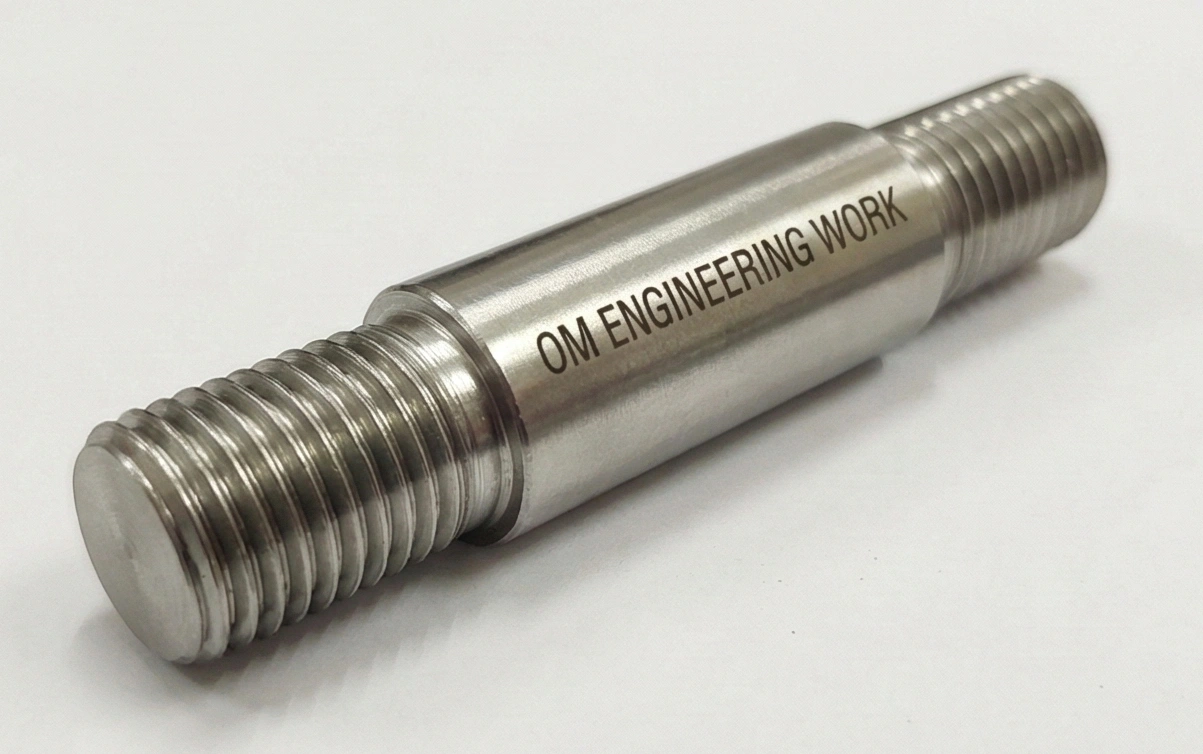
A Double End Threaded Stud (DIN 939) is a precision-machined fastener with threads on both ends and a plain shank in the middle. One end — the metal-end — is permanently screwed into a tapped hole in a base component (engine block, flange, housing), while the nut-end protrudes to accept a nut for clamping the mating component. The DIN 939 standard specifies the engagement length on the metal-end as 1.25 × nominal diameter, making it suitable for softer host materials such as aluminium, cast iron, and non-ferrous alloys.

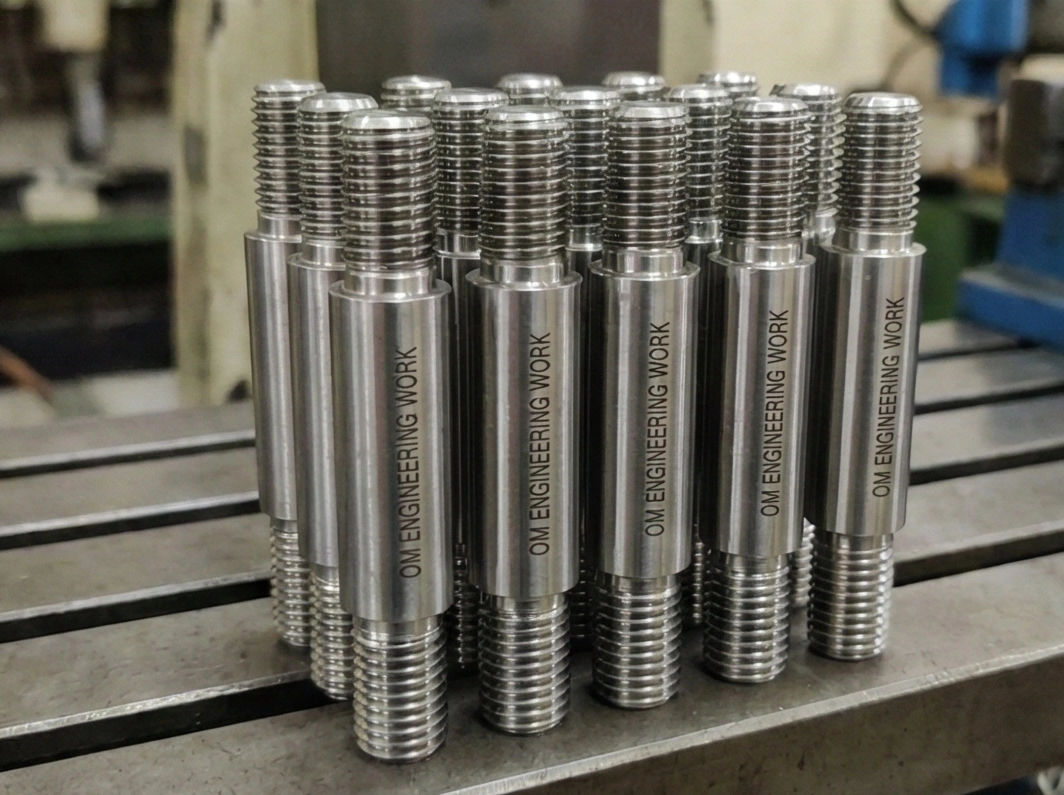
High-Tensile En8 Grade Steel (equivalent to C45 / AISI 1045) is the most widely specified material for threaded studs due to its excellent mechanical properties — tensile strength of 700–850 MPa and good machinability. At OM Engineering Works, we manufacture DIN 939 double end threaded studs on advanced CNC precision turned components lines and Traub automatic lathes at our Bhayandar, Mumbai facility, supported by full CNC machining infrastructure and inspection capability — delivering consistent thread geometry, dimensional accuracy, and a corrosion-resistant zinc plated finish across all production volumes.

Our manufacturing capability covers M6 to M64 metric threads, UNC from ¼" to 2½", as well as custom thread forms such as BSP, UNF, BA, and whitworth — all produced to DIN 939, DIN 938, ISO 4026, or customer-specified drawings.

Common Applications of Double End Threaded Studs:

  • Automotive & Engine Assembly: Cylinder head studs, exhaust manifold studs, intake manifold fasteners, engine block mounting
  • Heavy Engineering & Machinery: Flange bolting, gearbox housing assembly, pump casing fasteners, compressor head studs
  • Oil & Gas Pipelines: Pressure vessel flange connections, valve bonnet studs, heat exchanger shell-and-tube assembly
  • Power Generation: Turbine casing studs, generator end-bracket fastening, boiler flange connections
  • Construction & Infrastructure: Anchor bolts, structural steel connections, precast concrete panel fastening
  • Agricultural & Off-Road Equipment: PTO shaft studs, hydraulic pump mounting, cab frame fasteners

DIN 939 vs DIN 938 — Key Differences:

  • DIN 939: Metal-end engagement length = 1.25 × nominal diameter — recommended for aluminium, cast iron, and softer host materials
  • DIN 938: Metal-end engagement length = 1.0 × nominal diameter — used when the host material is steel or hard alloy
  • Custom Engagement Lengths: We also manufacture studs with 1.5d, 2.0d, or fully custom engagement lengths as per application drawing

Why Use Threaded Studs Instead of Bolts?

Threaded studs offer critical advantages in high-vibration, high-temperature, and frequent-removal applications — especially in assemblies manufactured using custom engineered CNC components for automotive and heavy engineering systems.

traub-turned-parts
Technical Details

DIN 939 Double End Threaded Stud — Specifications

Threaded Stud — Dimensional Specifications

StandardDIN 939 / DIN 938 / ISO 4026 / Custom Drawing
Materials AvailableEn8 (C45), En19 (Alloy Steel), SS 304, SS 316, Mild Steel
Manufacturing ProcessCNC Turning, Traub Auto Lathe, Thread Rolling / Cutting
Nominal Diameter RangeM6 to M64 (Metric) | ¼" to 2½" (UNC/UNF)
Length Range20 mm to 500 mm (custom lengths available)
Metal-End Engagement1.25 × d (DIN 939) | 1.0 × d (DIN 938) | Custom
Tolerance Capability±0.02mm shank | 6g thread class (ISO standard)
Thread Forms AvailableMetric (M), UNC, UNF, BSP, BSPT, BA, Whitworth
Thread StandardISO 965, ASME B1.1, DIN 13
Tensile Strength (En8)700 – 850 MPa (Heat treatment available up to 1000 MPa)
Quality StandardsISO 2768-m, First Article Inspection, Dimensional Reports

Surface Finish & Coating Specifications

Standard FinishZinc Electroplating (bright zinc, yellow passivation)
Zinc Thickness5–12 μm (to ISO 4042 / ASTM B633)
Alternative FinishesHot-Dip Galvanized, Black Oxide, Phosphate, Plain (bare), Nickel Plated
Surface Finish (Shank)Ra 1.6 to Ra 3.2 μm (ground finish Ra 0.8 on request)
Heat TreatmentInduction hardening / Through hardening available
Salt Spray Resistance72 hrs (standard zinc) | 240+ hrs (thick zinc + sealant)
Thread CoatingWax-coated, PTFE dry film, or plain per application
Certifications AvailableEN 10204 3.1 MTC, CoC, RoHS Compliance, REACH
Temperature Range-50°C to +300°C (material and coating dependent)
Production VolumePrototype (50 pcs) to Mass Production (100,000+ pcs)
Our Expertise

How We Manufacture DIN 939 High-Tensile Threaded Studs

01
Raw Material Procurement & Verification

En8 / C45 bright bar stock sourced from certified Indian and imported mills with EN 10204 3.1 Material Test Certificates. Chemical composition verified via PMI / spectrometer. Hardness verification (HB 179–229 for En8) before machining. Full heat number traceability maintained throughout production.

02
Bar Cutting & Pre-Machining

Bright bar stock cut to precise blank lengths on auto-saw with allowance for machining. Bar OD and straightness verified before loading onto Traub automatic lathe or CNC turning centre. Chamfers and run-out zones for thread run-ins prepared in this stage.

03
CNC Turning & Shank Machining

Plain shank turned to drawing diameter with ±0.02mm tolerance. DIN 939 metal-end and nut-end lengths turned to specification with correct run-out zones. Live tooling used for any cross-holes or flats. Chamfers at both thread run-in zones produced to DIN 78 standard.

04
Thread Formation — Rolling or Cutting

Threads formed via cold thread rolling — a process commonly used in our CNC turned components manufacturing — improves root strength by 20–30% vs cut threads...

05
Heat Treatment (Optional)

For applications requiring higher tensile grades (Grade 8.8, 10.9, 12.9 equivalent), studs are sent for through hardening or induction hardening at our approved heat treatment partner. Hardness verification post-treatment with Rockwell / Brinell tester. Straightness re-checked after heat treatment.

06
Zinc Plating, Inspection & Dispatch

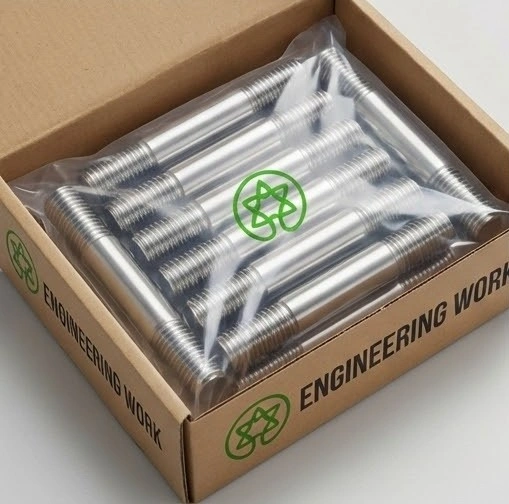
Batch zinc electroplated to ISO 4042 / ASTM B633 (5–12 μm). Post-plating hydrogen embrittlement relief bake for high-tensile grades. 100% visual inspection. Final Go/No-Go thread gauge check after plating. Full dimensional report and Certificate of Conformance prepared. Packed in anti-rust polybags and export cartons.

Machines & Equipment

  • 5× Traub Automatic Lathes (Ø4–Ø42mm)
  • CNC Turning Centres with live tooling
  • Thread rolling machines (M6–M48)
  • CMM (Coordinate Measuring Machine)
  • Thread gauges — calibrated Go/No-Go sets
  • Hardness tester (Rockwell / Brinell)

Quality Control

  • First Article Inspection (FAI) with report
  • 100% Go/No-Go thread gauge inspection
  • In-process CMM dimensional checks
  • Tensile / proof load testing on request
  • Coating thickness verification (XRF tester)
  • EN 10204 3.1 MTCs on all material grades
Material Options

Material Grades for High-Tensile Threaded Studs

En8 / C45 Medium Carbon Steel (Grade 8.8 Equivalent)

Properties: Medium carbon steel (0.40–0.50% C), tensile strength 700–850 MPa, good machinability, excellent toughness for vibration-prone applications. Industry standard material for DIN 939 studs.

Best For: Automotive engine studs, machinery flanges, general-purpose heavy engineering, agricultural equipment fasteners.

Standards:

IS 1570 En8 DIN C45 AISI 1045 BS 970 080M40

En19 / 4140 Alloy Steel (Grade 10.9 / 12.9 Equivalent)

Properties: Chromium-molybdenum alloy steel, heat-treated tensile strength 900–1100 MPa, excellent fatigue resistance, and toughness under dynamic loading. Preferred for critical fastener applications.

Best For: Oil & gas pressure vessel studs, power generation turbine fasteners, heavy-duty off-road vehicle components requiring 10.9 / 12.9 property class performance.

Standards:

IS 1570 En19 DIN 42CrMo4 AISI 4140 ASTM A193 B7

Stainless Steel SS 304 / SS 316 Threaded Studs

Properties: Austenitic stainless steel provides excellent corrosion resistance in chemical, marine, and food-grade environments. SS 316 offers superior chloride resistance. Lower tensile strength than carbon steel but eliminates corrosion-related maintenance.

Best For: Chemical plant flanges, marine deck fittings, food and pharma equipment studs, water treatment plant fasteners.

Standards:

AISI 304 / A2-70 AISI 316 / A4-70 DIN 1.4301 ASTM F593

Mild Steel (Grade 4.6 / 4.8) Threaded Studs

Properties: Low carbon steel (0.15–0.25% C), tensile strength 400–500 MPa, highly machinable and cost-effective. Suitable for non-critical static fastening applications where weight and cost are primary considerations.

Best For: Civil construction anchor studs, general fabrication, HVAC equipment mounting, non-structural assembly fixtures.

Standards:

IS 1367 Grade 4.6 DIN EN ISO 898-1 ASTM A307
Applications

Industries Using Our DIN 939 High-Tensile Threaded Studs

Automotive

Cylinder head studs, exhaust manifold fasteners, turbocharger mounting studs, brake caliper bolting, engine block assemblies

Oil & Gas

Pressure vessel flange studs, wellhead bonnet fasteners, pipeline manifold bolting, heat exchanger shell assembly

Heavy Engineering

Pump casing studs, gearbox flange fasteners, compressor head bolting, heavy machinery housing assembly

Power Generation

Turbine casing studs, generator bearing housing fasteners, boiler flange connections, steam line valve bonnet studs

Construction & Infrastructure

Structural anchor bolts, precast panel fastening, crane rail bolting, bridge deck connections, foundation studs

Marine & Defence

Deck equipment studs, marine engine mounting, naval vessel piping flanges, offshore platform structural fasteners

Agriculture & Off-Road

PTO shaft studs, tractor engine assembly, hydraulic pump mounting studs, combine harvester drivetrain fasteners

Chemical & Pharma

Reactor vessel flange studs, pressure autoclave fasteners, stainless steel SS316 studs for corrosive process environments

Product Comparison

OM Engineering vs Alternative Suppliers

Feature / Capability OM Engineering Works Typical Indian Supplier Off-the-Shelf Import
Thread Tolerance 6g / 6H class, ±0.02mm 6g approx (no report) 6g standard
Material Grades En8, En19, SS 304/316, MS — any grade Mild steel or En8 only Standard grades only
Custom Dimensions Fully Custom to Drawing / Sample Standard catalogue sizes only Standard DIN sizes only
MOQ 50 pieces (prototypes welcome) 500–1000 pieces 5000+ pieces
Material Test Certificate EN 10204 3.1 MTC Provided Basic mill cert or none Variable, often missing
Surface Finish Options Zinc, HDG, Black Oxide, Nickel, Plain Zinc plate only Zinc plate standard
Lead Time (Sample) 7–10 working days 15–25 days 45–90 days
Dimensional Report Full CMM + Thread gauge report per batch Rarely provided On request (extra cost)
Common Questions

DIN 939 High-Tensile Threaded Stud — FAQs

A double end threaded stud (DIN 939) is a fastener with threads on both ends and an unthreaded shank in the centre. The metal-end — with an engagement length of 1.25 × nominal diameter per DIN 939 — is screwed permanently into a tapped hole in the base component (e.g. engine block, pump housing). The protruding nut-end then accepts a nut or a second component that slides over the stud, secured with a nut and washer. This design eliminates the need to pass a bolt through the entire assembly and protects the tapped thread in the base component from wear during repeated removal and re-installation.

The difference lies in the metal-end (plant-in end) engagement length: DIN 938 specifies a metal-end length of 1.0 × nominal diameter, intended for use in steel or hard alloy host materials where a shorter engagement provides sufficient pull-out strength. DIN 939 specifies a metal-end length of 1.25 × nominal diameter, designed for softer host materials such as aluminium, grey cast iron, brass, and non-ferrous alloys, where the longer engagement compensates for the lower thread bearing strength of the material. We manufacture both standards, and also custom engagement lengths (1.5d, 2.0d) as per your application drawing.

Pricing depends on material grade (En8 vs En19 vs SS 316), nominal diameter and length, thread form, surface finish, and order quantity. Standard En8 zinc-plated metric studs in moderate quantities (500–1000 pcs) are highly cost-competitive from our Mumbai facility. High-alloy (En19, SS316) or heat-treated grades carry a material premium. We encourage you to share your drawing or specification via our quote form or WhatsApp — we provide detailed quotations within 24–48 hours with no obligation. Volume pricing available for orders above 1000 pieces.

En8 (also known as C45 or AISI 1045) is a medium carbon steel with 0.40–0.50% carbon content. It offers a balanced combination of tensile strength (700–850 MPa in normalised condition, up to 1000 MPa when heat-treated), toughness, and excellent machinability. For threaded studs, En8 is preferred because it threads cleanly — whether cut or rolled — achieves consistent dimensional accuracy, and after zinc plating provides good corrosion protection for industrial environments. It is the most widely specified material for Grade 8.8 equivalent fasteners and is available in a wide range of bar diameters from Indian mills at competitive cost.

Yes — 100% custom manufacturing to your drawing or sample is our core service. We accept 2D drawings (PDF, DXF, DWG), 3D models (STEP, IGES), or physical samples for reverse engineering. Non-standard engagement lengths, special thread pitches, shoulder diameters, cross-holes, flats, and custom surface finishes are all routinely produced. Our engineering team provides DFM (Design for Manufacturability) feedback if any features can be optimised for cost or performance. First article samples with full dimensional inspection reports are provided for your approval before batch production begins.

Thread rolling is a cold-forming process where thread profiles are formed by displacing material rather than cutting it. This produces a compressive stress layer at the thread root, which significantly improves fatigue strength (typically 20–30% higher than cut threads) and eliminates the stress concentration notch created by machining. Rolled threads also have superior surface finish (Ra 0.8 vs Ra 1.6 for cut threads), tighter dimensional consistency across high volumes, and no chip contamination risk. For high-tensile fasteners in vibration-prone applications such as engine studs, pressure vessel bolting, and heavy machinery, thread rolling is strongly recommended. We offer both rolled and cut threads and can advise which is appropriate for your load case.

Yes, OM Engineering Works regularly exports precision fasteners including DIN 939 threaded studs to the USA, UK, Germany, UAE, Saudi Arabia, Singapore, Australia, and other markets. We have experience with export documentation requirements including FORM-A (for GSP beneficiary countries), commercial invoice, packing list, certificate of origin, and EN 10204 3.1 material certificates. Components are packed to international export standards with thread protection caps, anti-rust VCI packaging, and wooden crate or carton export packing as appropriate. Lead times for export orders range from 10–21 working days depending on quantity.

Our minimum order quantity starts from 50 pieces for standard DIN 939 threaded studs, making us suitable for R&D prototyping, maintenance stock, and small-batch production as well as high-volume manufacturing. Prototype orders of 10–25 pieces are accepted for engineering validation samples — please mention "prototype" in your quote request. Volume pricing applies at 500, 1000, 5000, and 10,000 piece tiers.

Hydrogen embrittlement is a phenomenon where atomic hydrogen — introduced during acid pickling and electroplating — diffuses into the steel lattice and reduces ductility, leading to delayed fracture under tensile loads. It is a critical concern for high-tensile fasteners (Grade 10.9 and above). We prevent hydrogen embrittlement through: (1) controlling acid pickling time and temperature during pre-plating treatment; (2) post-plating hydrogen embrittlement relief baking at 190–220°C for 4–8 hours within 4 hours of plating (per ISO 4042 / ASTM F1941); and (3) for the highest-grade applications, specifying mechanical zinc plating (Sherardizing or mechanical deposition) which eliminates the acid pickling stage entirely. All high-tensile plated studs are supplied with a baking certificate on request.

We provide: EN 10204 3.1 Material Test Certificate (chemical composition and mechanical properties from the mill), First Article Inspection (FAI) Report with full dimensional measurements including thread, shank and length checks, Certificate of Conformance (CoC) confirming the order meets the specified DIN 939 / drawing requirements, Plating Certificate confirming zinc thickness and passivation specification, Hydrogen Embrittlement Relief Bake Certificate (for Grade 10.9 / 12.9 equivalents), and Tensile / Proof Load Test Report on request for structural or critical fastener applications. All documents are provided in digital PDF format on the day of shipment.
Related Capabilities

Explore Our Other CNC Machining & Fastener Services

Precision Turned Components

CNC turned shafts, pins, studs, and custom fasteners manufactured to tight tolerances for OEM industries.

Traub Machining Job Work

High-volume automatic lathe production for threaded parts, bushings, and precision industrial components.

Custom Engineered CNC Components

Fully custom machined components manufactured from drawing or sample for automotive and heavy engineering.

Ready to Order High-Tensile DIN 939 Threaded Studs?

Share your drawing or specification — receive a detailed quote within 24 hours. Minimum 50 pieces. Export-ready. EN 10204 3.1 MTCs provided. Mumbai-based manufacturing, globally delivered.

Get Threaded Stud Quote!