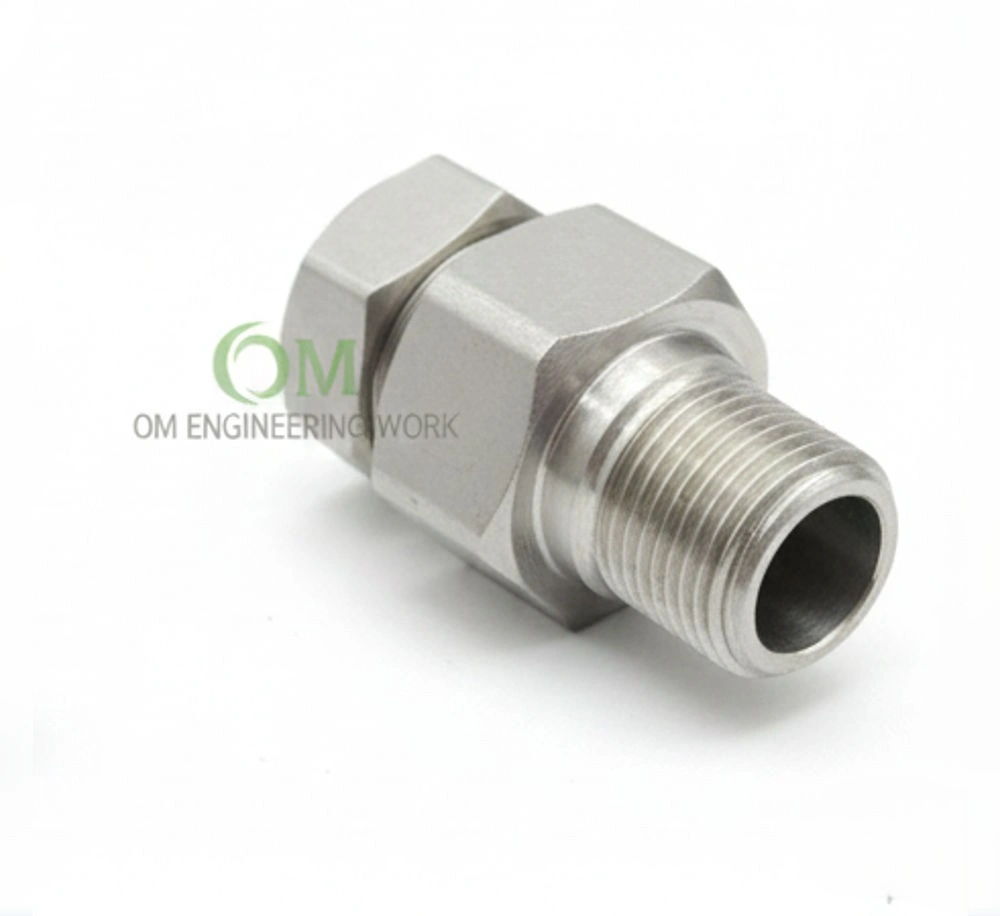
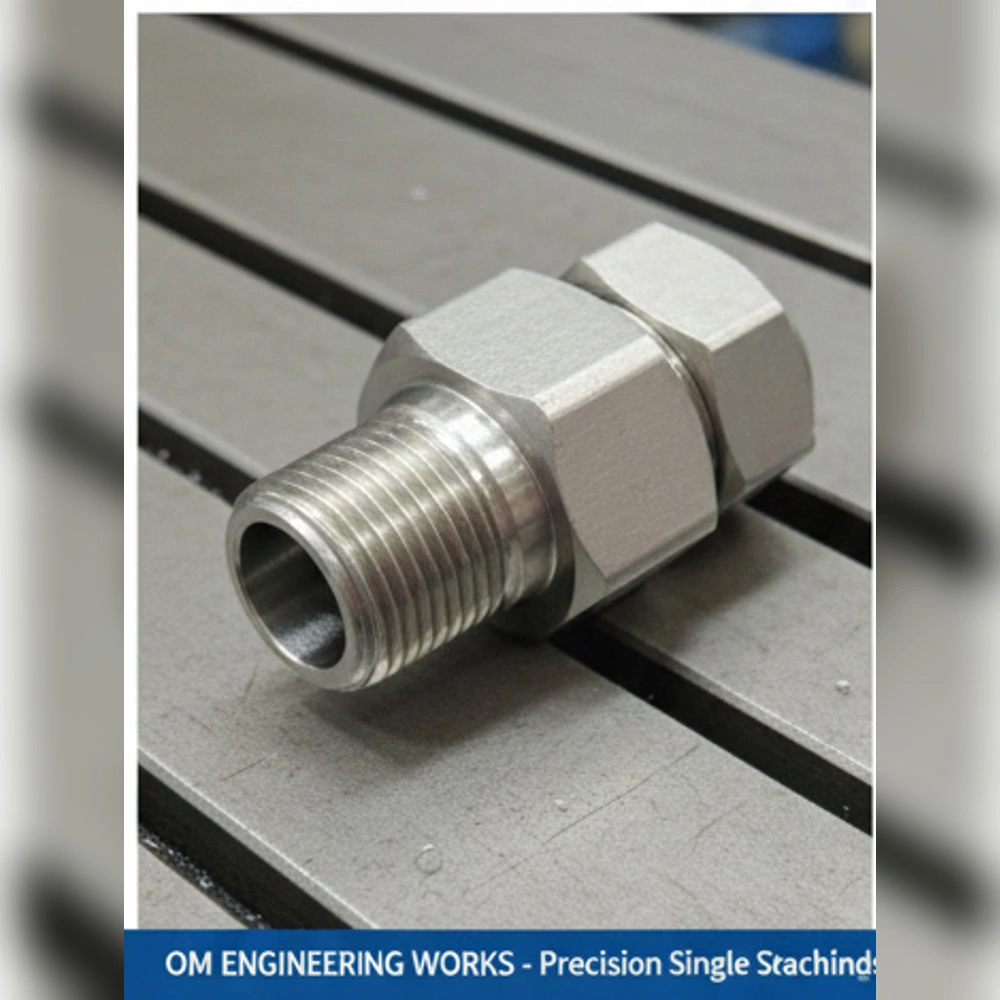
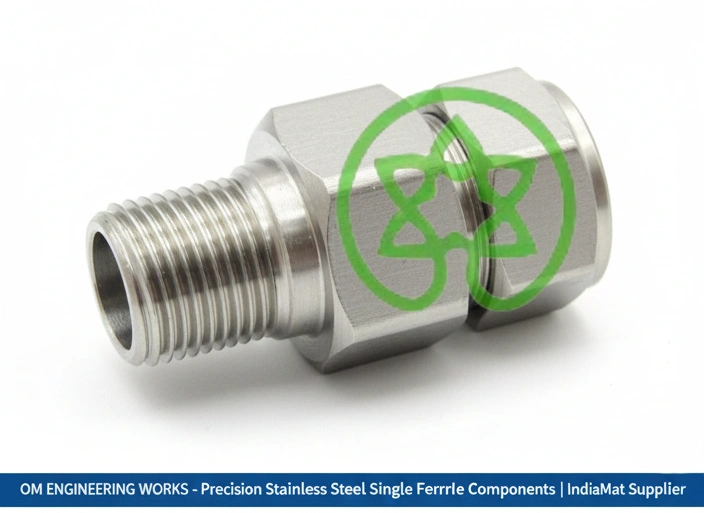
High-precision flareless ferrule connectors engineered for zero-leak performance in medium-pressure hydraulic, pneumatic, and process control systems. Utilizing an advanced single-piece compression ferrule, these SS 316 fittings provide superior grip and vibration resistance up to 6000 PSI without requiring special flaring tools. Manufactured in Mumbai, exported globally.
In industrial instrumentation, process control, and high-pressure fluid transfer, a leaking connection is not just an inconvenience—it's a massive safety hazard. Single Ferrule Compression Fittings provide a secure, leak-tight seal without the need to flare, weld, or thread the tubing. By simply tightening the nut, the ferrule is forced forward into the fitting body, causing its leading edge to compress and "bite" firmly into the outer wall of the tube.
At OM Engineering Works, we manufacture these critical three-piece assemblies (Nut, Body, and Ferrule) using our advanced CNC turning centers. The geometry of the ferrule is the most critical element; we machine the cone angles to an exacting ±0.05mm tolerance. This ensures that the bite is deep enough to hold up to 6000 PSI, yet controlled enough so it doesn't crush the tube or restrict internal fluid flow.
Operating out of our facility in Mumbai, we exclusively utilize premium Stainless Steel 316/316L for these fittings. This guarantees outstanding resistance to harsh chemicals, offshore saline environments, and extreme temperature fluctuations. The single-piece ferrule design is highly favored for its simplicity, reduced part count, and ease of installation in tight spaces.
| Fitting Type | Single Ferrule Compression Tube Fitting |
|---|---|
| Tube OD Sizes (Fractional) | 1/16", 1/8", 1/4", 3/8", 1/2", 3/4", 1" |
| Tube OD Sizes (Metric) | 3mm, 6mm, 8mm, 10mm, 12mm, 16mm, 20mm, 25mm |
| Machining Tolerance | ±0.05mm (Critical for ferrule bite depth) |
| Configurations Available | Male/Female Connectors, Unions, Elbows, Tees, Bulkheads |
| Thread Options (Body) | NPT, BSPT, BSPP, UNF |
| Manufacturing Process | High-Speed CNC Turning, Multi-Axis Machining |
| Pressure Rating | Vacuum to 6000 PSI (Dependent on tube wall thickness) |
| Primary Material | Stainless Steel 316 / 316L (Dual Certified) |
|---|---|
| Alternative Materials | Brass, Monel, Hastelloy, Duplex SS (On request) |
| Ferrule Hardness | Specially treated/hardened to ensure it bites into SS tubing |
| Standard Finish | Electropolished (Enhances corrosion resistance and purity) |
| Thread Treatment | Silver plating on nut threads (prevents galling during assembly) |
| Operating Temperature | -325°F to 1200°F (-198°C to 648°C) |
| Compliance | NACE MR0175 / ISO 15156 compliant materials |
| Certifications | EN 10204 3.1 Material Test Certificates (MTC) provided |
We source heavy-duty SS 316/316L hex and round bar stock from certified mills. Full material traceability via MTC is established immediately, ensuring the molybdenum content is correct for pitting and corrosion resistance in marine/chemical environments.
The raw stock is fed into our highly rigid CNC turning and milling centers. The internal cone angle of the body is machined with extreme precision. If this angle is off by even a fraction of a degree, the ferrule will not compress evenly, leading to a catastrophic blowout at high pressures.
The single ferrule is the heart of the fitting. It must be machined to a strict ±0.05mm tolerance. The front edge must be razor-sharp to bite the tube, while the back must form a robust arch to absorb vibration. We often apply specialized surface hardening to the ferrule so it remains harder than the tubing it is biting into.
Stainless steel threads are notorious for "galling" (cold welding together under friction). We cut ultra-smooth threads on the nut and body. Furthermore, the internal threads of the compression nut are often silver-plated or specially lubricated to ensure smooth, repeatable tightening.
The components are thoroughly deburred and undergo electropolishing. This electrochemical process removes microscopic surface burrs, enriches the chromium layer for maximum rust resistance, and creates a highly sanitary, shiny finish ideal for process instrumentation.
Cone angles and threads are inspected using optical comparators and thread ring gauges. The three parts (Body, Ferrule, Nut) are assembled finger-tight to protect the ferrule during transit, and securely packed in export-ready, moisture-proof cartons.
Properties: The absolute gold standard for fluid and gas instrumentation. The addition of Molybdenum provides exceptional resistance to pitting and crevice corrosion, particularly in chloride-rich (saline) environments. The "L" grade indicates low carbon, which prevents carbide precipitation during any potential system welding.
Best For: Offshore oil rigs, chemical processing plants, analytical instrumentation, hydrogen gas lines, and high-pressure hydraulic systems.
Standards:
Properties: Highly machinable and cost-effective, brass offers excellent natural corrosion resistance to water and non-corrosive gases. It provides excellent sealing properties but cannot handle the extreme pressures or aggressive chemicals that SS 316 can.
Best For: Medium-pressure pneumatic air lines, standard water cooling systems, and general factory automation instrumentation.
Standards:
Providing secure, blowout-proof connections for pressure transmitters, sample cylinders, and analytical sensing lines on offshore rigs.
SS 316 fittings resist degradation from aggressive solvents, acids, and caustic chemicals running through control manifolds.
Electropolished SS 316 ensures high purity and prevents bacterial buildup in sanitary fluid and gas transfer lines.
Connecting rigid tubing to heavy machinery, capable of withstanding massive pressure spikes and constant system vibrations.
| Feature / Capability | Single Ferrule Compression Fitting | Standard Threaded Pipe Fitting | Flared Tube Fitting (JIC) |
|---|---|---|---|
| Installation Method | Simple wrench tightening (No prep) | Requires cutting threads & applying sealants | Requires special flaring tools & tube prep |
| Vibration Resistance | Excellent (Ferrule acts as a spring) | Poor (Threads loosen under vibration) | Good |
| Flow Restriction | None (Tube ID remains fully open) | Mild restriction | Tube end thinning can cause turbulence |
| Reusability | High (Can be remade multiple times) | Low (Threads wear down) | Moderate |
| Pressure Capability | High (Up to 6000 PSI) | Medium/High | Medium/High |
Explore our full range of high-pressure NPT and BSP threaded adapters, hex plugs, and reducing bushings in SS and Brass.
Custom CNC turning services for specialized fluid control valves, manifold components, and hydraulic spools.
Automated Traub machining for rapidly producing thousands of specialized nuts and ferrules with highly repeatable accuracy.
Share your tube sizes, thread types, or project requirements for a rapid B2B quote. We guarantee ±0.05mm precision tolerances and supply verified SS 316 with full MTCs. Mumbai-based manufacturing, exported globally to the instrumentation sector.